
More than 1 in 5 Australian women (22%) have experienced sexual violence since the age of 15, according to the ABS Personal Safety Survey 2021-22. Personal safety alarms, sometimes called rape alarms, are one simple tool that can help you draw attention and get help fast. Many now have a siren rated 130 dB, but a loud alarm only helps if you carry it and know how to use it.
Your personal safety alarm needs to work in the moment you need it. In this guide we explain how a 130 dB personal alarm works, what to look for when you choose one, and how to carry and use it so it’s ready when it counts.
Table of Contents
What Is a Rape Alarm and How Does a 130 dB Chirpie Work?
A rape alarm, also known as a personal safety alarm, is a small but powerful device that makes an attention-grabbing sound when you’re in danger. These compact devices work as non-violent deterrents you can carry anywhere.
Personal Safety Alarm Basics
Personal safety alarms work with a simple activation system. Most, including every Chirpie, have a pin you pull to set off the alarm. Many alarms are rated around 120 decibels [1], and every Chirpie has a siren rated 130 dB. That’s loud enough to be painful at close range and to be heard from a long way off.
These alarms do more than make noise. Research from the University of North Carolina at Charlotte suggests offenders often leave when a loud alarm goes off [1], and the sound gets the attention of people nearby.
How Sound-Based Deterrents Function
Sound-based deterrents work on two simple principles. The sound startles attackers and gives you time to escape. The piercing noise also gets attention from people nearby, making it likely someone will help.
Attackers hate drawing attention to themselves [4]. A loud, distinctive sound can throw off their plans and make them think twice. The sudden, unexpected noise triggers a fight-or-flight response that usually makes them run away instead of continuing their attack.
Chirpie Features
The Chirpie Infinity is rechargeable by USB-C and does two jobs: it has a siren rated 130 dB and a flashing strobe, plus a torch button on the side to light your way. The strobe also helps people see you in the dark.
The Chirpie Link adds Bluetooth. Paired with your phone, pulling the pin can also trigger your phone’s built-in Emergency SOS, which can call emergency services and share your location, depending on your phone and its settings. There’s no app to install and no subscription. Our Link setup guide explains how it works on iPhone and Android.
Every Chirpie uses a pull-pin you can grab quickly in an emergency. On the Fusion models the pin stays attached, so there’s nothing to drop or lose.
Do personal alarms actually work?
A personal alarm can’t stop an attack on its own, and it isn’t meant to. What it can do is:
- Startle an attacker with a sudden, very loud noise, which can give you a moment to get away
- Draw attention, because most attackers don’t want to be seen or heard
- Signal for help to people nearby, and the flashing strobe helps them find you in the dark
An alarm works best where other people are within earshot, such as streets, car parks, campuses and public transport. If you often walk, run or work alone somewhere quiet, pair it with your phone’s Emergency SOS and let someone know your route. The Chirpie Link can trigger your phone’s Emergency SOS when you pull the pin, depending on your phone.
Selecting the Loudest Personal Safety Alarm for Your Needs
How loud an alarm is matters when you need to be heard. Most personal attack alarms are rated between 120 and 140 decibels [6].
Understanding Decibel Ratings and What They Mean
The decibel scale isn’t linear: every 10 dB increase sounds roughly twice as loud. A siren rated 130 dB sounds around twice as loud as a 120 dB alarm. Sounds above about 120 dB can be painful at close range, which helps startle an attacker and gives you a chance to get away [10].
Key Features Beyond Volume: Lights, GPS, and Connectivity
Volume makes a difference, but extra features boost your protection. Many high-end alarms come with strobe lights that help others spot you at night [11]. The latest models let you share your location with emergency contacts through GPS tracking. Some alarms connect to your phone through Bluetooth and add extra features. This combination of features creates better protection than just sound.
Which Chirpie Is Right for You?
Every Chirpie has a siren rated 130 dB and a flashing strobe. The Chirpie Original keeps things simple with replaceable coin batteries and is our lowest-cost alarm. The Chirpie Infinity is rechargeable by USB-C and adds a torch, which suits daily commutes and walking at night. The Chirpie Link adds a Bluetooth trigger for your phone’s Emergency SOS, depending on your phone. The Infinity Fusion and Link Fusion have a pin that stays attached. See Which Chirpie is right for you? to compare all five.
Portability and Carrying Options
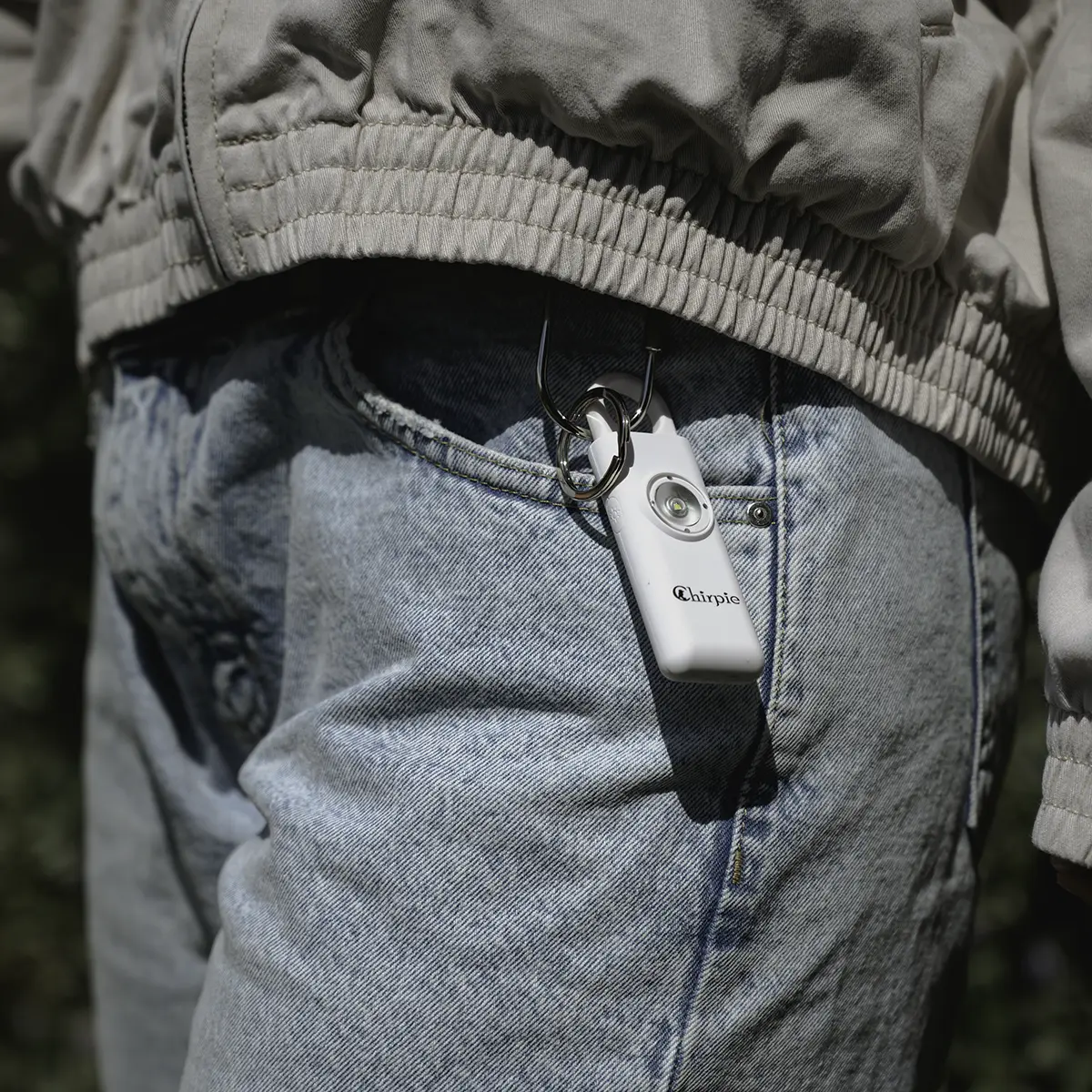
The best alarm won’t help if you can’t reach it in an emergency. Every Chirpie is small and light enough to clip onto your keys, bag or belt, so it’s ready when every second counts [14].
Proper Usage Techniques: Maximizing Your Personal Alarm’s Effectiveness
Your personal safety device works best when you know how to carry and use it in emergencies. The loudest rape alarm won’t help if you can’t reach it fast enough during a threat.
Optimal Placement and Carrying Positions
The way you carry your Chirpie or any personal alarm device matters most. You should attach it to items you always have with you – keychains, belt loops, or bag straps make perfect spots [15]. Athletes and outdoor enthusiasts can clip the alarm right on their clothes where they can see and grab it [15]. You should never keep your rape alarm buried at the bottom of your bag – it’s impossible to get to it fast that way.
Quick-Draw Techniques for Emergency Situations
Time is critical when you face a threat. Make sure you can reach your alarm and check it’s properly attached before you head out. To use a Chirpie, grip the alarm and pull the pin: the siren and strobe start straight away and keep going until you push the pin back in.
Practice Drills and Muscle Memory Development
Simple as it seems, you need regular practice to use your alarm right. Your body needs to learn how to grab and activate your personal alarm through repeated actions. Scientists call this “motor memory” – it’s a type of movement skill that sticks with you longer than other memories [19]. Your brain builds stronger neural pathways just for this emergency response as you practice more [20].
Studies show that physical practice in real-life situations helps your body remember better [20]. Try reaching for your rape alarm in different situations – while you walk, sit, or move around in dark places. This training turns conscious actions into automatic responses, so your body knows what to do even when fear takes over [20].
Don’t just practice turning it on – work on your whole response plan. This includes moving to lit areas and finding help after the alarm goes off.
Integrating Your Rape Alarm with Other Safety Measures
A personal alarm device is one part of a multi-layered safety system that security experts recommend. The loudest rape alarm works best when it’s part of a bigger safety plan that protects you in many ways.
Creating a Complete Personal Safety Strategy
Safety plans help reduce your risk in dangerous situations [22]. A good strategy starts by spotting possible threats in your daily routine and environment. You should develop backup plans for times when you walk alone, travel to new places, or face home intrusions [24]. Your safety plan should be available yet secure—share it with someone you trust [22].
A complete strategy needs these essential parts:
- Emergency contact information (know at least one important phone number by heart)
- Quick ways out of places you visit often
- Safe meeting spots with people you trust
- Ready responses to different threats [24]
Combining with Situational Awareness Training
No alarm replaces good situational awareness. Paying attention to what’s around you gives you more time to react if something feels wrong.
Stay off your phone in public to focus on what’s around you [24]. Keep your Chirpie alarm handy while you practice awareness skills. Look around, find exits, and stand tall—these actions can stop attackers before they strike.
Digital Safety: Pairing Physical Alarms with Safety Apps
The Chirpie Link can trigger your phone’s built-in Emergency SOS, depending on your phone. Safety apps such as bSafe add features like live location sharing and trip tracking [27].
These digital tools can work alongside your physical rape alarm to create a safety system that connects personal and public security [27]. Modern safety apps include GPS tracking, emergency alerts, and quick access to local authorities. This gives you better protection than any single device alone.
Conclusion
Personal safety alarms are powerful tools against potential threats, especially when combined smoothly with a complete security strategy. A Chirpie gives you a siren rated 130 dB and a flashing strobe, and the Chirpie Link can also trigger your phone’s Emergency SOS, depending on your phone.
Research suggests loud alarms can deter attackers and draw attention from people nearby. Sound-based deterrents work well on their own, but they become even more effective when you pair them with good situational awareness and digital safety measures.
You need the right tools and knowledge to stay safe. Practice with your personal alarm helps build muscle memory for quick reactions in emergencies. On top of that, it helps to stay aware of your surroundings and keep your device available at all times to create a strong foundation for personal security.
The best personal safety strategy uses multiple layers of protection. Physical devices, digital tools, and proper training all work together. Learning to maximize each component’s effectiveness, especially your rape alarm’s features, improves your chances of staying safe by a lot in threatening situations.
References
[1] – https://www.covesmart.com/resources/alarm-systems/guide-to-personal-alarms/
[2] – https://safelife.com.au/product/personal-panic-alarm/
[4] – https://www.soloprotect.com/uk/blog/are-personal-attack-alarms-effective
[5] – https://www.ishn.com/articles/113375-taking-a-holistic-approach-to-safety
[6] – https://www.safewise.com/best-personal-alarms/
[9] – https://www.sabrered.com/personal-alarms
[10] – https://www.covesmart.com/resources/alarm-systems/guide-to-personal-alarms/
[11] – https://chirpie.com.au/
[13] – https://chirpie.com.au/about-us/
[14] – https://www.streetdefender.com/faq.htm
[15] – https://www.sabrered.com/how-to-use-a-personal-alarm/
[19] – https://scopeblog.stanford.edu/2022/07/15/the-science-behind-muscle-memory/
[20] – https://modelmugging.org/martial-science/muscle-memory-operant-condition/
[22] – https://www.thehotline.org/plan-for-safety/create-your-personal-safety-plan/
[24] – https://www.aus.com/blog/strategies-personal-safety-and-security
[26] – https://hollieguard.com/
[27] – https://www.getbsafe.com/